

6 marine travel agencies & platforms for crew changes in 2026
Quick summary
Crew changes can be handled in different ways, from marine travel agencies to self-service platforms and hybrid providers that offer both. We compared 6 options to show how they differ in who handles bookings and changes, what support is available out of hours, how they charge and which type of crewing team they may suit best.
See the table below for a side-by-side comparison.
Provider | Type | How you book | Out-of-hours help | How it charges | Best for |
|---|---|---|---|---|---|
C Teleport | Crew travel platform | Your team books, changes and cancels on desktop or the app | 24/7 support for bookings and disruptions, on chat and email | Fixed fee per ticket, agreed in your contract; no C Teleport fee for online changes or cancellations | Crewing teams that want direct control of changes |
ATPI | TMC with a marine division | ATPI consultants or self-booking in CrewHub | 24/7 service | Customer-specific; not published | Teams that want consultants plus self-booking |
BCD Travel | TMC with an Energy, Resources & Marine division | Self-service or agent-assisted in TripPlanner | 24/7/365 | Not published | Fleets that want self-service and agents in one tool |
FCM Travel | TMC with a marine and offshore service | FCM travel technology with marine/offshore specialist support | 24/7 | Not published | Teams that want travel technology alongside specialist marine/offshore support |
Clyde Travel Management | Marine and energy travel specialist | Clyde consultants supported by Consort | 24/7/365, at no extra cost | Not published | Teams that want specialist consultants plus a shared workflow platform |
Tilla | Crew change platform | Your team manages flights in Tilla, with travel agents able to work in the same platform | Not stated on its site | Not published | Teams managing more of the crew change workflow in one platform |
Who should handle your crew changes: your team or an agency?
For many crewing teams, a short-notice port change still means emailing or calling an agent and waiting for new flight options.
That works if you want an agent involved in every booking. But crewing teams that prefer to make changes directly can use self-service platforms to search fares and book, change or cancel flights themselves. Some agencies also offer self-booking tools alongside their consultants, giving teams a mix of direct control and agent support.
The better fit depends on who you want handling changes, how much control your team needs, and the support you expect out of hours.
Why listen to us?
Crewing teams use C Teleport to book and manage crew changes every day. MF Shipping Group cut its crew change processing time by 98%, with a median booking time of about 2 minutes 45 seconds. Miray International also saved 100 working days using the platform.
That experience has shown us where crew change workflows tend to break down, especially when plans change at short notice or outside normal working hours. We used those same practical considerations to compare the providers on this list, including who controls the booking, what support is available and how each provider charges.
We used to go through a travel agency for every flight. It was a lot of back and forth, waiting for replies, following up, and dealing with delays. We also struggled to get a clear view of the travel costs. It wasn’t easy to track or report on anything. Now we just book flights ourselves. It’s quicker, we see all the options, and the pricing is clear. C Teleport made our travel management so much simpler.
What are marine travel agencies and crew change platforms?
A marine travel agency handles flights, hotels and other arrangements for crew joining or leaving a vessel. Some specialise in shipping and offshore; others are global TMCs with a marine division. In the traditional model, a consultant finds, books and changes the itinerary, although some agencies now add self-service tools.
A crew change platform puts more day-to-day booking control in the crewing team's hands. Depending on the product, your team may search fares, book or change flights, manage documents, or plan the wider crew change. Compare what users can actually do rather than the label alone.
Across the providers on this list, the main points to compare are:
- Marine fares: Find eligible marine or seaman fares where the airline, route and crew member meet the fare rules.
- Crew changes: Coordinate sign-ons and sign-offs, then adjust the itinerary when a port call or vessel schedule changes.
- Documents: Manage or get support with visas, letters of guarantee and other proof an airline or destination may require.
- Out-of-hours help: Know who can act when a connection is missed or a crew change moves at 03:00.
The 6 marine travel agencies and platforms worth comparing
The 6 providers below cover agency-led, self-service and hybrid approaches to crew changes. C Teleport appears first because it’s our platform; the other 5 are listed in no particular order.
1. C Teleport
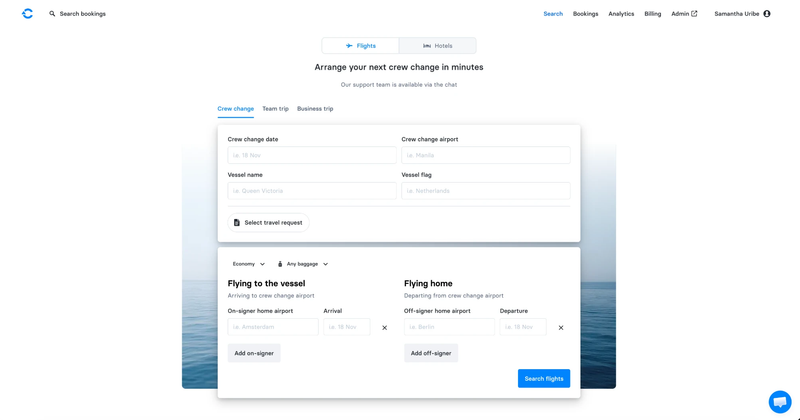
C Teleport is a crew travel platform that lets crewing teams book, change and cancel crew flights and hotels themselves. We switch marine and energy fares on for your account. Your bookers then pick them when they search, next to public and negotiated fares, and add the vessel name and flag.
You'll notice the difference most when a port call changes at short notice. Your team can change or cancel eligible flights directly, without emailing an agent and waiting for options. And if something goes wrong at 03:00, our support team is available through chat, with 24/7 help for bookings and disruptions.
That's what changed for Dutch Offshore when it stopped depending on a travel agent. Its crewing team now books from the app, even after hours. As MF Shipping Group’s crew coordinator Stephanie Kanon puts it, "…now with C Teleport, it’s getting more efficient. If necessary, I can arrange a crew change in five minutes"
We also connect to maritime crewing systems like COMPAS, Mintra and Cloud Fleet Manager. What each one sends and receives depends on the integration, so see our integration partners page for the detail, or how marine crewing teams use the platform day to day.
What you get
- Crew travel bookings: Book flights for on-signers and off-signers in one place, without waiting on an agent.
- Mobile app: Book and change crew flights on iOS or Android, away from your desk.
- Approvals: Approve or decline out-of-policy flights from desktop or mobile.
- Hotels: Book crew hotels in the same platform as flights.
- Crew profiles: Keep passport details on file, so a booking starts from a name.
- Duty of care: Send crew itineraries to International SOS with a configured duty-of-care integration.
- Data security: Keep crew data under ISO/IEC 27001:2022 certified security management, hosted in EU-based AWS regions.
Pricing
We charge a fixed fee per ticket, agreed in your contract before you book. Ask our sales team for the terms. There’s no C Teleport fee when you change or cancel online. Card fees, airline and hotel charges, and changes or services via our support team may still carry a fee.
Pros
- A crew change that's rebooked three times online doesn’t pick up three change fees from us.
- Marine, energy and aircrew fares are all in one platform, which suits groups with vessels and offshore sites.
- Your team sees the fares directly, so you can benchmark them against agency quotes.
Cons
- Your own team does the booking, so someone has to own crew changes day to day.
- Marine fares depend on each airline's rules and routes, so some crew changes will only have public fares.
- The per-ticket fee isn't on our website, so you'll need a quote.
2. ATPI
ATPI is a Manchester-based travel management company, and its Marine & Energy division says it has more than 100 years of marine experience. The company changed hands in September 2025, when Direct Travel bought it.
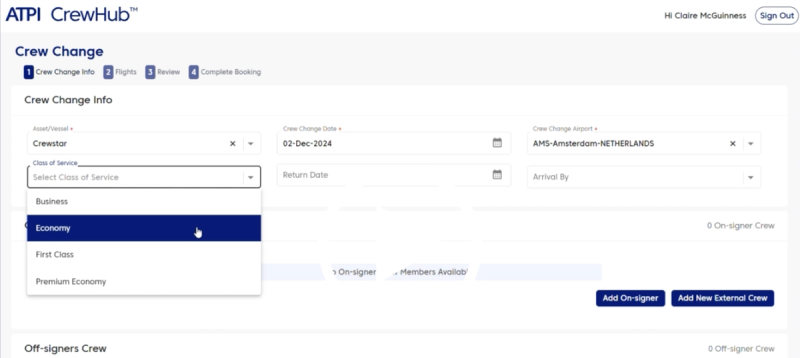
ATPI runs a hybrid service, so you get consultants and a self-booking tool from the same provider. Its consultants handle itinerary changes and emergencies through a 24/7 service desk, while your crewing team can book flights directly in CrewHub (ATPI’s self-service booking platform).
A single booking can include multiple crew members travelling from different starting points, which is useful when arranging a whole crew change.
What you get
- Marine fares: Book crew on ATPI's global marine fares.
- Visa help: Get support with visas and fast-track security from ATPI's consultants.
- Short booking form: Fill in five fields per CrewHub booking, then filter flights by cost and speed.
Pricing
ATPI has no public pricing. Its UK terms describe a price list set for each client, so you'll get a quote for your account.
Pros
- You can mix consultants and self-booking, crew change by crew change.
Cons
- ATPI's CrewHub page doesn't say whether your team can change or cancel bookings there, so ask before relying on it.
3. BCD Travel
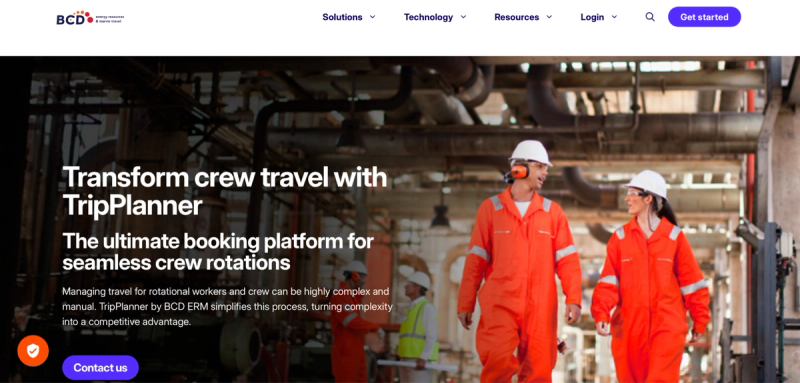
BCD Travel’s Energy, Resources & Marine division, BCD ERM, handles crew travel and brings more than 30 years of sector experience. The wider BCD Travel group serves clients in 170+ countries.
BCD's crew tool, TripPlanner, connects to crew planning systems. Your team can book and make last-minute changes online, or go through BCD's consultants, in the same tool. That suits crewing teams that want to handle routine crew changes themselves while keeping agents available when needed.
What you get
- Fare comparison: Compare marine, corporate, public and low-cost fares in one search.
- Crew housing: Book crew accommodation alongside flights.
- Travel requirements: See visa regulations, destination alerts and health advisories as part of the crew travel workflow.
- Global support: Reach BCD's support team 24/7/365.
Pricing
BCD does not publish TripPlanner pricing, so you’ll need to contact the company for commercial terms. You can also book a demo through its site.
Pros
- You choose self-service or an agent for each booking, in the same tool.
- You can get a free travel programme audit before you commit.
Cons
- TripPlanner pricing isn’t published, so you’ll need to contact BCD to compare service costs.
4. FCM Travel
FCM Travel is the flagship corporate travel brand of Flight Centre Travel Group. Its marine and offshore team has decades of sector experience, with dedicated teams in 97+ countries.
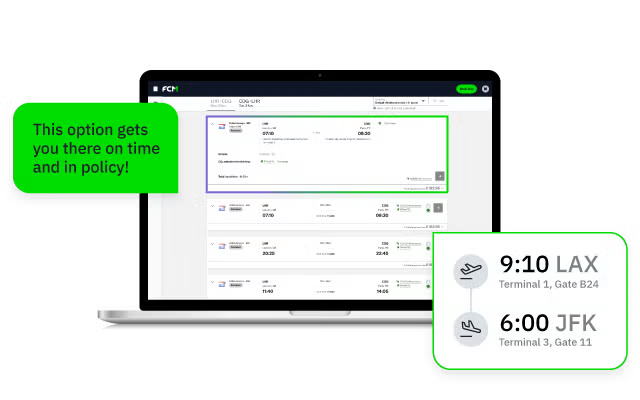
FCM combines its travel technology with specialist marine and offshore support. Its team plans crew travel around rotation schedules, builds in contingency options and monitors trips in real time, while FCM Platform provides booking and travel-management tools across the wider service.
What you get
- Negotiated offshore fares: Access fares negotiated for marine and offshore travel.
- 24/7 marine support: Reach FCM’s marine and offshore specialists when plans change or disruption hits.
- Travel technology: Use FCM’s platform for booking and travel management, with consultant support available when needed.
- Risk alerts and tracking: Monitor trips and receive updates when disruption or risk affects crew.
- Charter options: Arrange charter travel when scheduled services can’t reach the required location.
Pricing
FCM does not publish a standard marine and offshore price list. Its terms state that change and cancellation fees follow your FCM contract or agreed fee schedule, alongside any applicable airline or supplier charges.
Pros
- Combines travel technology with 24/7 marine and offshore specialists.
- Supports rotation planning, negotiated fares, disruption management and charter requirements.
Cons
- FCM does not publish its marine service fees, so you’ll need commercial terms to compare costs.
5. Clyde Travel Management
Clyde Travel Management specialises in marine and energy travel and has more than 30 years of experience moving crews. It’s part of Northern Marine Group, a Stena Group company.
Clyde combines consultant support with Consort, its proprietary crew travel platform. Consort brings crewing managers, crew members and Clyde’s travel consultants into the same workflow, while Clyde’s Downsell system keeps checking held bookings for lower fares until 24 hours before departure, even after ticketing.
What you get
- Marine fares: Access marine airfare contracts across more than 80 airlines.
- Dedicated contact: Work with a travel manager who gets to know your account and crew requirements.
- Visa support: Get help with visa requirements, fare negotiation and disruption management.
- Five-country footprint: Clyde has wholly owned entities in the UK, USA, Sweden, Norway and Finland.
Pricing
Clyde does not publish its pricing, so you’ll need to contact the company for commercial terms.
Pros
- 24/7 support is available at no extra cost.
- Consort keeps crew, crewing managers and Clyde’s consultants in the same workflow.
Cons
- Clyde’s public Consort pages do not clearly spell out which booking changes your own team can make without a consultant, so confirm that if self-service is important to you.
6. Tilla
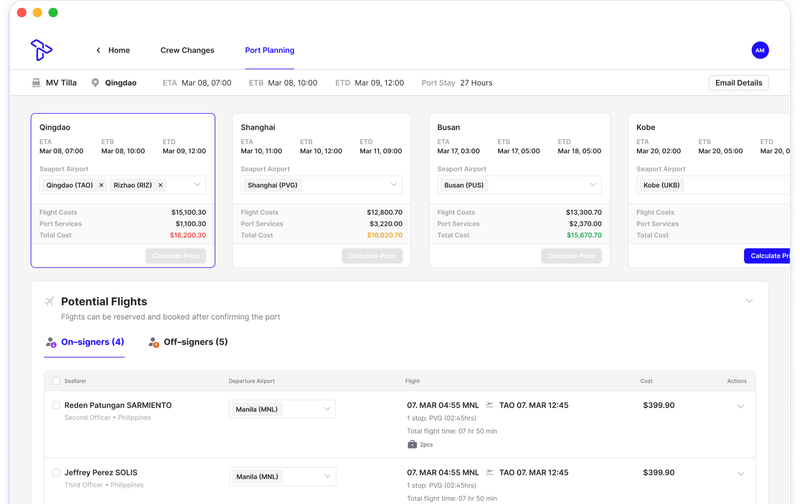
Tilla, founded in Berlin in 2021, provides crew change software that it says is trusted by 600+ vessels. It lets crewing teams plan and manage crew changes alongside the travel agencies they already work with.
Inside Tilla, your team can search seaman and public fares, book and rebook flights, and manage e-tickets. Travel agents can also work in the platform, which lets operators take more control of crew changes without necessarily replacing their existing agencies.
What you get
- Port agency comparison: Compare port agencies, services and costs when planning a crew change.
- Travel requirements: See visa and travel requirements for crew members during planning.
- Travel document checks: Get document recommendations for each crew member.
- Crewing system links: Tilla currently lists planned integrations with systems including Mintra OCS, Lloyd's Register Cloud Fleet Manager and SeaCrew.
Pricing
Tilla does not publish pricing on its site, so you'll need to contact the company for commercial terms.
Pros
- Covers more of the wider crew change workflow, including port planning, flights, travel requirements and agency collaboration.
Cons
- Tilla's public site does not state that 24/7 support is available, so confirm who handles urgent changes out of hours.
How we compared the 6 providers
We reviewed each provider’s public website in October 2026 and focused on the operational differences that matter most during crew changes:
- Who makes the change: Your team in a booking tool, the provider’s consultants, or both.
- Out-of-hours support: What help is available when disruption happens at 03:00, through which channel and whether extra charges apply.
- Marine fares: Whether the provider offers marine or seaman fares and how eligibility is handled.
- Crewing system links: Whether the provider connects with the crewing software your team already uses.
- How it charges: Whether the fee model is published and whether booking changes can add service fees.
We didn’t rank providers by fare price because marine fares vary by airline, route, travel date and fare conditions.
How to choose the right provider for crew changes
Start with who you want handling a crew change when plans shift at short notice.
If your crewing team needs to book, change and cancel flights directly, a self-service platform may be the better fit. If you prefer an agent to manage those changes, look at agency-led providers. And if you want both, shortlist providers that combine self-booking with consultant support.
If you’re already using an agency but questioning whether the setup still works for your team, these signs your travel agent is holding you back can help you assess the current workflow before comparing alternatives.
Once you’ve narrowed the options, test each provider against what happens during a real crew change:
- Who can make a change when plans shift at 03:00?
- Can your own team rebook or cancel without waiting for an agent?
- How are marine fare eligibility and crew documents handled?
- Does the service connect with your existing crewing systems?
- What fees apply to bookings, changes, cancellations and out-of-hours support?
- If you operate offshore, can the provider support fixed rotations or arrange charters when needed? See how C Teleport handles energy and offshore crew travel for 14/14 and 28/28 rotations.
FAQs
What is a marine fare?
A marine fare, also called a seaman fare, is an airline fare for eligible crew travelling to join or leave a vessel for work. Eligibility, baggage allowances, change conditions and refund rules vary by airline, route and fare, and crew must carry the documents required by the airline. You’ll find more detail on our seaman fares page.
Who is eligible for marine fares?
Crew travelling to join or leave a vessel for work may qualify for marine fares, but each airline sets its own eligibility rules. Required proof can include a seaman’s book, employer letter or employment contract, depending on the carrier. On Air France, KLM and Delta, for example, rig and platform workers go on energy fares rather than marine fares.
What is a letter of guarantee for seafarers?
A letter of guarantee is a company letter explaining why a crew member is travelling. It typically includes details such as their name, destination, passport number, travel route and the vessel or platform they are joining. It also confirms that the company will take responsibility for repatriation if required. See our guide to marine travel documents for more detail.
What does OK to Board mean for crew?
An OK to Board is airline clearance that may be used when a crew member does not yet have the required visa but a local agent can arrange a visa on arrival. The local agent contacts the airline and guarantees that the visa and other immigration formalities will be completed on arrival.
The process depends on the destination, airline and crew member’s nationality. If a visa cannot be arranged on arrival, an OK to Board cannot be issued and the visa must be sorted before departure. See our guide to OK to Board arrangements for more detail.
Can you book seaman tickets online?
Yes, if your booking platform carries marine fares and your account is enabled for them. On C Teleport, industry fares are switched on per account and your booker selects the relevant fare type when searching.
The crew member still needs the proof of eligibility required by the airline, such as a seaman’s book, employer letter or employment contract. Without the required documents, the airline may deny boarding or refuse the benefits attached to the fare.
Want more control over crew changes?
C Teleport lets your crewing team book, change and cancel flights directly, with 24/7 chat support for bookings and disruptions when needed.
Book a demo to see how the workflow works for your fleet, or contact sales to discuss fares and pricing.
Marie-Clare Boyes