

Marine travel agency vs crew travel platform: which should run your crew changes?
Compare a marine travel agency with a crew travel platform on quotes, fees, out-of-hours changes and what you give up when your crewing team books directly.
Quick summary
A marine travel agency handles crew flight bookings and changes for you, usually through a consultant or account team. A crew travel platform lets your own crewing team search, book and change flights directly, including marine fares where the crew qualify. Choose an agency if you'd rather hand off the booking work. Choose a platform if your crew changes get rescheduled often and you want your team to make changes directly.
Why marine travel agencies became the default for crew flights
For years, booking crew flights has meant going through a specialist agency. One reason is access to marine fares. Many airlines distribute these fares through approved or selected travel sellers. Qatar Airways, for example, limits its marine and offshore fares to selected travel agencies and specialist marine travel management companies.
Some crew travel platforms now offer marine fares too, so a traditional agency is no longer the only option. The key difference is who handles the work. With an agency, a consultant searches, books and makes changes on your behalf. With a platform, your own team does those things directly.
So what changes when your own team takes over the booking, and what do you give up?
Why listen to us?
MF Shipping Group used to spend at least four to five hours booking and processing a crew change with its travel agency. On our platform it has cut that processing time by 98%, and its median booking now takes about 2 minutes 45 seconds.
Miray International swapped its offline agency for our platform and has saved nearly 100 working days. Dutch Offshore left its traditional travel agent so the team could book and change crew flights itself, at any hour.
All three made the switch you're weighing up, so we've seen what changes at the crewing desk, and what stays the same.
We used to go through a travel agency for every flight. It was a lot of back and forth, waiting for replies, following up, and dealing with delays. We also struggled to get a clear view of the travel costs. It wasn’t easy to track or report on anything. Now we just book flights ourselves. It’s quicker, we see all the options, and the pricing is clear. C Teleport made our travel management so much simpler.
Marine travel agency vs crew travel platform: an overview
Both routes can give eligible crew access to marine fares. They differ mainly in who does the booking and who controls the change when plans move. That affects how you get a price, how you pay and how quickly a change can be made.
| Marine travel agency | Crew travel platform | |
|---|---|---|
| Who books the flights | A consultant, usually from your email or call | Your crewing team, directly in the platform |
| How you get a price | Ask for options, wait for a reply, compare quotes by hand | Run one search and see fares with their change and refund rules |
| Marine fares | Through the agency's airline agreements | On platforms that offer them, for eligible crew |
| Changes and cancellations | The consultant makes them after receiving your request | Your team makes them directly, on desktop or mobile |
| Out of hours | Many specialist agencies offer a 24/7 desk, and additional out-of-hours service fees may apply | Self-service at any hour, with support depending on the platform |
| How you pay | Transaction or management fees; some contracts also include supplier commissions or overrides | A fee per booking or trip, a subscription, or a mix |
| Visas and OK to Board | Some agencies help through visa partners and port agents | Your team or port agent arranges them, and some platforms add visa checks |
| Holding a fare | A consultant may hold a reservation until the airline's ticketing time limit | Some platforms book straight away and issue the ticket as late as possible |
| Spend visibility | Reports and invoices from the agency | Booking data you can export into your own reports |
| Who you rely on | A consultant who knows your crew and routes | Your own team, backed by the vendor's support desk |
What is a marine travel agency?

A marine travel agency is a travel agency that books flights, hotels and transfers for seafarers and offshore crew. It specialises in marine fares, which many airlines distribute through approved or selected travel sellers.
When a crew change comes up, you email or call with the details, like who's signing on and off, at which port and when. A consultant comes back with flight options, books the ones you approve and issues the tickets. If the vessel arrives late, you get in touch again and they rebook.
Good specialist agencies know the routes, the transit rules and the airports your crew pass through. They can also combine airlines or split a ticket to get a seafarer a seat. Some agencies now run an online booking tool alongside their consultants, too.
Key features
- Marine fare contracts with a range of airlines, plus the routing skill to combine carriers on awkward journeys
- A consultant or account team who gets to know your fleet, your crew and your usual crewing ports
- Out-of-hours rebooking support, with many specialist agencies offering a 24/7 desk
- Help with visas and port arrangements at some agencies, through visa partners and port agents
- Invoicing and reporting handled for you, often consolidated across vessels
Pricing
Transaction fees are the most common model across business travel. According to BTN's 2025 State of the Industry Report, 71% of buyers pay their travel management company per transaction. That means you pay for each booking, while changes, refunds and after-hours support may carry additional fees depending on your contract.
Other contracts use a management fee. For example, New Zealand's public-sector travel management contract allows a management fee based on total travel spend. It also allows providers to retain commissions and rebates from suppliers in return for a lower booking fee.
Your actual fees depend on your agreement, so check what you pay for bookings, changes, cancellations and out-of-hours support.
Pros and cons
Pros
- Your team hands off the work, because the consultant searches, books, issues tickets and rebooks.
- Specialist agencies can offer marine fares and bring routing knowledge for more complicated crew journeys.
Cons
- If your process relies on email or phone, you wait for the consultant to return quotes and make changes.
- Comparing quotes from two or three agencies, then checking them against airline sites, can become slow manual work.
- Depending on the contract, transaction fees and supplier commissions can make the total cost harder to compare at a glance.
What is a crew travel platform?
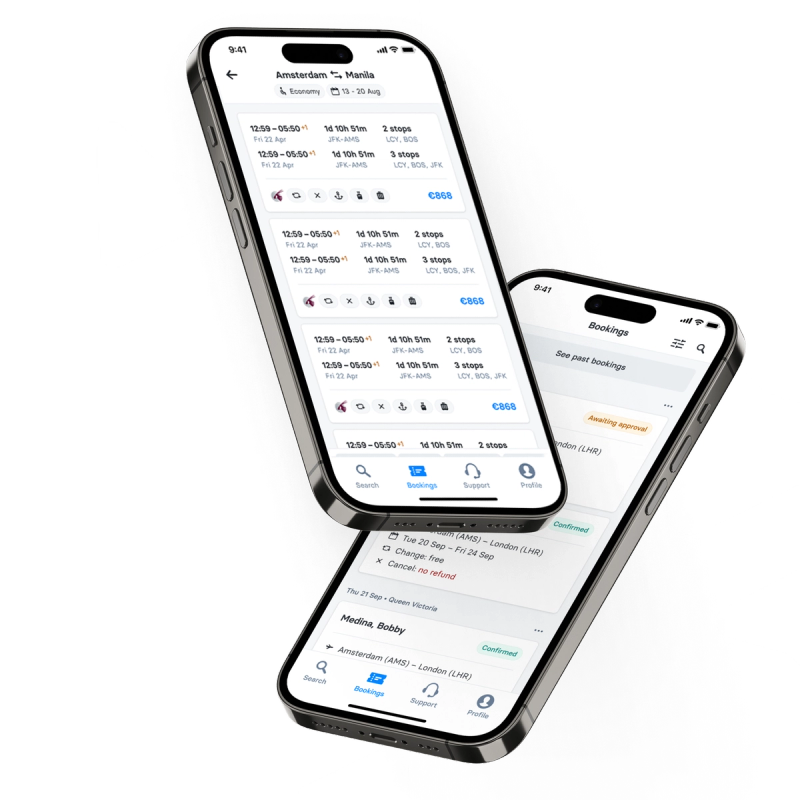
A crew travel platform is booking software your crewing team uses to search, book, change and cancel crew flights and hotels itself. Some platforms also provide access to marine fares for eligible crew.
Your crewing officer searches for the crew change and compares flights and their fare rules in one place. They can then book the required crew travel and update the booking from a laptop or phone when the vessel's schedule changes.
Behind the platform there's a support desk for anything your team can't sort out alone. Some platforms also connect to the crewing system you already use, so nobody has to type crew change details in twice.
Key features
- Marine and public fares in one place, where the platform offers them and the crew qualify
- Bookings, changes and cancellations made by your own team, on desktop or mobile
- Tools for managing crew change bookings in one place
- Travel policies and approval steps you set yourself
- A support desk for problems, which some platforms staff around the clock
Pricing
You pay a platform under a contract too, with a subscription, a fee per booking or trip, or a mix of both.
C Teleport charges a fixed fee per ticket, agreed in your contract before you book, and what you see is what we invoice. There’s no C Teleport fee when you change or cancel online. Card payments, airline and hotel charges, and changes made for you by our support team can still carry a fee.
Pros and cons
Pros
- Your team can change a booking as soon as a crew change is rescheduled, without waiting for someone else to make the change.
- One search can show flights alongside their fare rules, so you're not chasing quotes from several agencies.
- Booking data stays in one place and can be exported to your own reports, which makes spend easier to track.
Cons
- Your team does the booking, so the work and responsibility for getting it right come in-house.
- A platform doesn't replace a local port agent, so OK to Board messages, visas and port arrangements may still sit with your team or port agent.
4 key differences between a marine travel agency and a crew travel platform
1. How you compare fares for a crew change
With an agency, you send the crew change details, wait while the consultant searches, then get a shortlist of flights by email. Stephanie Kanon, a crew coordinator at MF Shipping Group, described the wait with the company's previous agency: “It was taking four or five hours at least before we'd get a flight update with options, and then you'd have to confirm it.”
That process gets more time-consuming when your company requires several quotes. If you need three, you're chasing three replies, one from each agency. Danica Crewing Specialists, for example, compares fares from three different travel agencies for its crew travel. You may have agency quotes in one place, airline fares in another and a separate fare search open alongside them. From there, you compare marine fares with public fares and different routing options.
On a platform, you check the fares yourself in one place. You can see each flight's price alongside its change and refund rules, then book the option that works. If your procurement policy still asks for a benchmark, compare the platform's price with one or two agencies for the same crew change. Our guide to benchmarking fares against agencies walks through how to set that up.
2. How each one gets paid
With a marine travel agency, a transaction-fee contract can mean additional fees when a booking changes. According to the UK's Business Travel Association, a change that needs a new ticket usually brings a new transaction fee. A split ticket, meaning two one-ways in place of a return, can also count as two transactions. Some contracts include research fees for calls that don't end in a booking, which can add up when you ask several agencies to quote.
Then there's supplier income. Before Covid, two thirds of a typical travel management company's revenue came from suppliers such as airlines and hotels, according to the BTA. Some agencies retain commissions or rebates alongside the fees paid by the customer. And if your management fee is set as a percentage of travel spend, that fee rises when your spend does.
Crew travel platforms can use a different pricing model, such as a subscription or fee per booking or trip. The key difference is that the platform fee does not necessarily increase every time a booking changes.
Let's say a crew change for four people gets rescheduled twice before anyone flies. If your agency contract charges a fee for the original ticket and for each change, that's three fees per person, or twelve fees across the four crew members. C Teleport doesn’t charge for those two changes when your team makes them online, although the airline’s fee or a fare difference can still apply. Cathay Pacific's marine and energy fares, for example, include free changes.
Whichever route you choose, get the fee structure in writing, including transaction or management fees and whether supplier commissions are retained.
3. Who changes the booking when a crew change is rescheduled
At Miray International, around half of crew flights need changing or cancelling, and someone has to make each change. With an agency, that someone is a consultant. You call or email, and they make the change after receiving your request. Many specialist agencies also offer out-of-hours support.
A platform puts that control in your team's hands. Whoever spots the new schedule can change the booking straight away. On C Teleport, your team can change or cancel a booking in under two minutes, on desktop or in the mobile app. If you get stuck, our 24/7 disruption support can help.
“Even when I'm at home watching TV, I can quickly open the app and make changes,” says Miray's HR Manager, Aliza Zaidi. “I don't have to call anyone.”
4. What you give up when you leave your agency
A platform gives your team more direct control, but it also brings some responsibilities in-house. Know which is which before you switch.
You give up a consultant who knows your crew, your vessels and their transit airports, and who makes the booking decisions for you. On a platform, your own team does the booking and makes those decisions, so getting it right becomes your responsibility.
Some agencies help with visas through partners and keep in touch with the port agent during a crew change. If yours does, you'll lose that help too.
We don't act as a local agent, so your team or port agent arranges OK to Board messages. According to Qatar Airways, those are normally handled by the shipping agent or shipping company. We do give you an advisory visa checker, plus crew lists and letters of guarantee you can download in a couple of clicks.
Holding a fare works differently, too. An agent can hold a reservation until the airline's ticketing time limit, though the price isn't guaranteed until the ticket is issued. C Teleport doesn't hold seats, and tickets are issued as late as possible, which can give you more opportunity to cancel before ticketing if the crew change falls through.
There's also duty of care to think about. Some agencies include duty of care tools in their service. We can send booking details to your duty of care provider, such as International SOS, if you ask us to.
And if a journey goes wrong, your team is fixing a booking it made itself, with our support desk behind it. As Helen Misseris, crew superintendent at Seacrew Management, puts it, “It is easy to use, and you are in charge 24/7 if something goes wrong, without relying on finding travel agents after office hours.”
FAQs
Can I book marine fares online?
Yes. Crew travel platforms let you search and book marine fares online. The airline's rules apply wherever you book, though. For instance, Lufthansa Group requires the vessel's name in a marine booking. Finnair also sets eligibility and documentation requirements for its marine fares, so keep your crew's proof of eligibility to hand.
Who is eligible for marine fares?
Each airline sets its own rules, so check the carrier every time. Expect your crew to need proof of eligibility, such as a seaman's book or employer documentation.
Are marine fares cheaper than regular fares?
Not always. Compare the marine fare with available public fares for the same itinerary, while also considering the fare rules and flexibility.
Cathay Pacific's marine fare, for example, includes two checked bags in economy and free changes on eligible Cathay-operated flights.
Can a crew travel platform and a travel agency work together?
Yes. Running both for a while can be a practical way to test a platform. You could book routine crew changes on the platform and keep your agency for charters or complicated routings. Then compare the time and cost after a few months.
If you benchmark fares along the way, check the same crew change with one or two agencies at the same time. That way, you're comparing the same flights under similar conditions.
Agency or platform: how to choose your next step
Keep your agency if your crew changes are rare, your routings are complicated or you'd rather someone else handled every booking while you wait. A platform makes more sense when crew changes are frequently rescheduled and your team wants more direct control. That's especially true if you're comparing quotes by hand, waiting on replies or your contract charges for each change.
If that sounds like your crewing desk, book a demo and see how a crew change works on C Teleport. You can also read how marine crewing teams use our platform. If you'd like to talk through fares and pricing first, contact our sales team.
Lennart Straeter